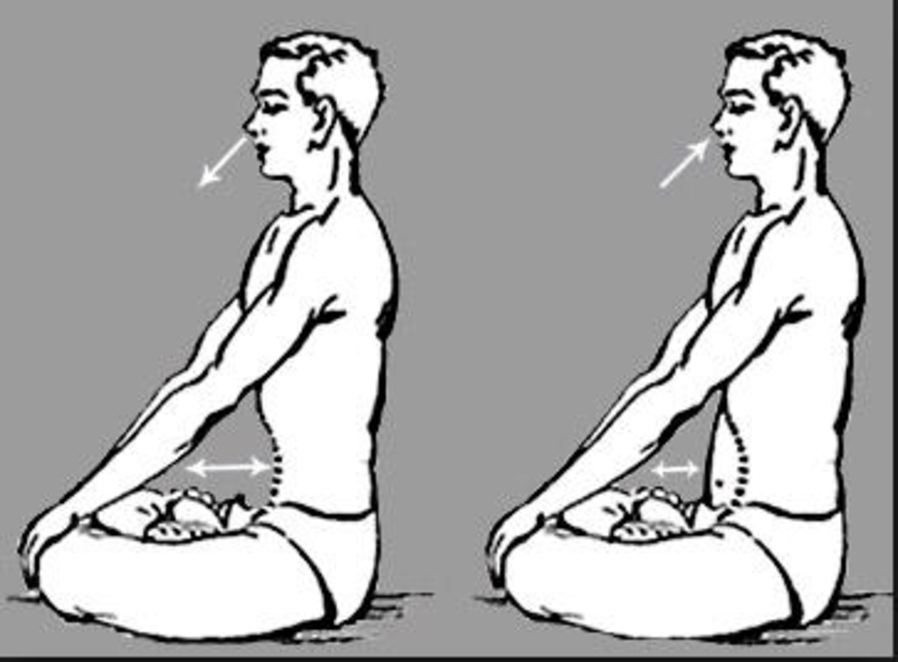
Bhastrika Pranayama is also known as the Bellows Breath. In the days before central heating homes were heated by open fires and people used ‘bellows’ to get the fire going. A strange object – bellows mimic lungs – and were used draw air from the room and then blow it into the fire to increase the heat. In a similar way, the practice of Bhastrika Pranayama increases the flow of air into the body to produce an inner heat both at physical and subtle levels.
Bellows breathing is a good practice to boost your energy. It’s also very helpful to focus an agitated mind and is useful when practiced prior to relaxation or meditation to enhance the affects.
Students begin practice slowly and build up in speed and capacity. The benefits of rapid Bhastrika are to increase the exchange of oxygen and carbon dioxide into and out of the bloodstream. The result is to stimulate the metabolic rate, producing heat and flushing wastes from the system. As we build up to this advanced practice by working steadily and slowly we can notice a great improvement in the muscle tone in the abdomen and diaphragm. The pushing and pulling action of the abdomen also massages the organs and the digestive system. It can be helpful to reduce swelling in the throat and any accumulation of phlegm.
As Bhastrika Pranayama requires the use of a forceful breath, anyone with abdominal issues, heart issues (including high blood pressure) or other chronic complaints should stick to gentle Abdominal Breathing. This can be done in a more relaxing lying down position.
STAGE 1 – ABDOMINAL BREATHING
To begin learning Bhastrika Pranayama we must first be very comfortable with Abdominal Breathing. In class we visualise this as ‘blowing up a balloon in the tummy’. You can do it lying down or in a seated posture. Have one hand on the tummy and one on the chest.
Settle for a few breaths, relaxing the mind and body.
Breathing in, imagine that you are sending the breath down into your tummy, feel the tummy expand.
Breathing out, imagine that your sending the breath from the tummy up and out through the nose. Squeeze your tummy muscles to ensure all the air is sent back out.
Keep going like this, trying to keep the chest still.
This type of breathing encourages the lower parts of the lungs to fill up. Thus using the whole of the lungs. We are also using the diaphragm to it’s full range and improving the tone of this muscle. As oxygen is our main source of energy making each breath just a little better is one of the best ways we can improve our overall health.
Other benefits of this deeper type of breathing include massaging the organs, including the heart muscle.
Once this breathing technique is mastered we can move onto Bhastrika Pranayama.
STAGE 2 – SLOW BHASTRIKA PRANAYAMA
Work as per the Abdominal breathing for a few rounds to get the rhythm going.
Bring to mind the Bellows and begin to work the abdomen like a bellows – exaggerating the movements forward and backward, as if you are pulling air into the tummy and then pushing it out. Be slow and methodical. You should feel as though you are really working your abdominal muscles. I’m always surprised in class that I can really see people’s tummies moving out and then in!
After about 10 rounds, inhale deeply then exhale deeply. Allow your breath to settle back to your normal. You can do another round if you wish, but as with all our practices little and often is the key.
STAGE 3 – BHASTRIKA PRANAYAMA
Once the abdominal muscles and diaphragm are sufficiently toned (this make take a few years) students can build up in both speed and quantity. I have been taught to do 3 rounds of up to 40 breaths as a maximum.
If you have a serious health condition, I would strongly recommend working with an experience yoga teacher.
Always take the deep breath in and out at the end of each round.
Always rest and settle the breath before moving onto another practice.
Discover more from do yoga! with deb
Subscribe to get the latest posts sent to your email.